
Solar power and EV charging: turning obligations into performance
Rooftop solar over car parks and EV chargers are too often handled separately. Steer them together via the EMS and supervision, and a regulatory obligation becomes a performance lever.

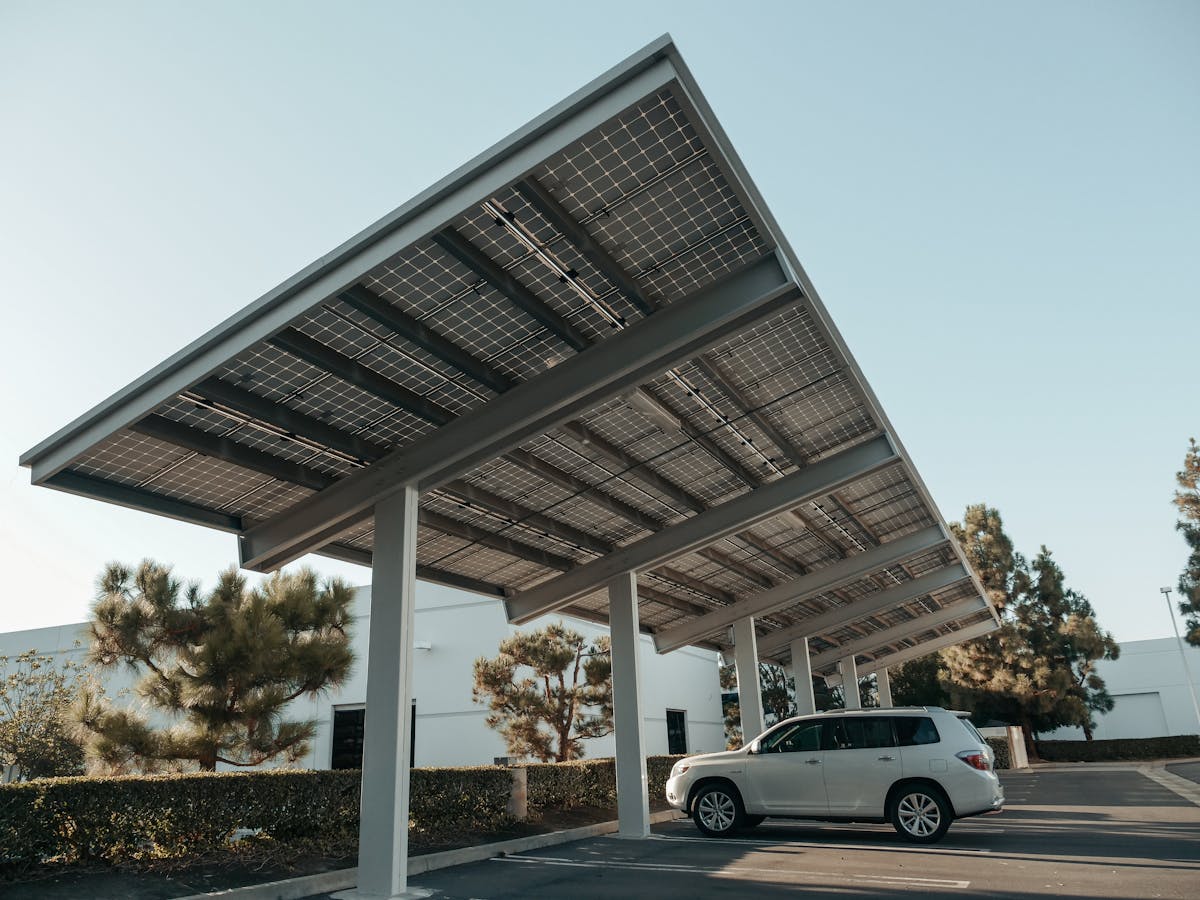
In recent years, companies have seen new obligations emerge around energy and mobility, prompting them to rethink how their sites are designed. Solar power over car parks, EV charging infrastructure, building-scale energy management: these are all topics that now feature in real-estate and industrial projects.
In practice, these topics are still too often handled independently. Solar installations are designed as standalone production units, while charge points are deployed without real integration with the rest of the site’s energy usage. The result: poorly valued solar production, charge points mostly powered by the grid, and investments whose economic potential remains largely under-exploited.
Yet by combining solar power, EV charging and energy steering, it is possible to radically change the picture. Local production, smart charging and, where relevant, battery storage make it possible to optimise self-consumption, reduce energy costs and improve the overall profitability of the infrastructure. This approach is all the more relevant as projects and tenders now incorporate broader scopes, combining EV charging, energy and smart building.
In this context, supervision stands out as a structuring building block. By offering a unified view of the infrastructure — charge points, solar production, batteries and building usage — it makes it possible to steer the whole coherently and turn constrained investments into levers of economic and operational performance.
Regulation: new constraints for companies
The French regulatory framework has played a decisive role in this evolution. The LOM law frames and accelerates the deployment of EV charging infrastructure in tertiary, industrial and commercial buildings, as well as in the associated car parks. In parallel, the APER law requires a large share of outdoor car parks over 1,500 m² to be equipped with photovoltaic canopies, in order to develop local renewable electricity production.
These texts reflect a clear direction: mobilising already-built surfaces to support the energy transition and the electrification of usage. They create a framework favourable to the convergence of energy production and electric mobility, encouraging companies to integrate these topics into a holistic reflection on their site.
While regulation sets the objectives, it nonetheless leaves players great freedom over the means deployed. It is precisely in this space that the difference plays out between projects that are merely compliant and infrastructure that is genuinely high-performing — able to leverage local production to power new electrical uses, in particular vehicle charging.
Integrating solar and EV charging: the central role of the EMS and supervision
Faced with these new obligations, simply placing infrastructure side by side is no longer enough. Installing photovoltaic canopies on one side and charge points on the other, with no link between the two, amounts to under-exploiting costly assets. To create value, it is essential to connect the energy systems together and steer them in a coordinated way.
This integration relies on an Energy Management System (EMS) able to aggregate and analyse all the site’s energy flows: solar production, building consumption, any battery storage and the needs related to EV charging. The EMS acts as an orchestrator, arbitrating the use of locally produced energy based on the site’s technical, economic and operational constraints.
That said, the EMS cannot act in isolation. Value creation depends on its ability to communicate with charge point supervision in order to directly influence charging strategies. An agnostic, interoperable supervision platform can then take control of the stations, dynamically adjust the power delivered and synchronise charging with periods of high solar production.
This approach profoundly changes the role of operators and installers. It is no longer simply a matter of deploying infrastructure to meet a regulatory constraint, but of offering global solutions able to address energy, economic and operational challenges. By combining EMS and supervision, infrastructure operators can move further along the value chain: operating installations on behalf of developers, optimising their performance over time and developing recurring revenue tied to operation and energy steering, rather than being limited to a purely CAPEX model.
In a context where projects increasingly incorporate multiple building blocks — solar, EV charging, batteries, smart building — this ability to steer the whole becomes a major differentiator and a lever for sustainable value creation across the ecosystem.
Concrete business benefits for developers and operators
When solar power, EV charging and supervision are conceived as a coherent whole, the benefits go far beyond mere regulatory compliance. Energy integration then becomes a genuine lever of economic performance.
The first impact is a significant reduction in the overall energy cost. By prioritising locally produced electricity to power charge points, companies reduce their dependence on the grid and amortise their solar investments more quickly. This logic is all the more relevant in a context where reselling electricity injected into the grid is becoming less and less attractive, both economically and contractually. Consuming locally becomes more profitable than feeding back into the grid.
Integration also makes it possible to leverage periods of high solar production. When production is abundant, supervision can authorise faster or simultaneous charging of a large number of vehicles, at no extra energy cost. This flexibility opens the way to differentiating uses: charging at very low cost, even close to free, directly indexed to local production.
At the end-user level, this approach makes it possible to offer a kilometre that is at once green and economically optimised, powered by an electron produced on site. For companies and sites open to the public, this argument becomes a powerful lever for attractiveness and image, in line with their environmental commitments.
For infrastructure operators, the benefits are just as structural. By relying on a supervision platform like Chargekeeper, they no longer merely install equipment, but operate complete energy infrastructures on behalf of developers. Some operators supported by Chargekeeper are already deploying photovoltaic canopies coupled with charge points on large retail car parks. Thanks to intelligent steering of the whole, they can offer electricity at very low cost during solar production peaks to attract customers, while optimising the profitability of the infrastructure.
This ability to finely steer energy and charging creates a lasting competitive advantage. It makes it possible to develop models based on recurring operating revenue, to address more complex tenders and to position EV charging and solar not as regulatory constraints, but as genuine engines of value for the sites equipped.
Towards infrastructure conceived as a whole
The joint deployment of solar power and charging infrastructure marks a profound shift in how tertiary, commercial and industrial sites approach their energy. When local production, charging and steering are conceived as a coherent whole, this infrastructure ceases to be simple equipment and becomes a genuine lever of performance.
Integration plays a key role here. By linking solar, EV charging, EMS and supervision, it becomes possible to optimise the use of energy produced on site, reduce operating costs and bring out sustainable models adapted to the challenges of smart building and electric mobility.
In this spirit, Chargekeeper supports players in the sector — operators, installers, developers and site owners — in the design and operation of global solutions. The platform is already deployed on projects combining EV charging and solar, in interoperability with third-party EMS. Fully agnostic and accessible via API, supervision makes it possible to build open, scalable architectures aligned with the operational needs of the market.
This approach is part of a continuous co-construction effort. At the end of 2025, the Chargekeeper teams were present at Energaïa in Montpellier to exchange with the ecosystem, and will be at EnviroPro Sud-Est in 2026 to continue these conversations and contribute, alongside field players, to developing the energy and EV charging solutions of tomorrow.